Every licence type above is searchable online. Physicians are on the Medical Board of California's look-up, registered nurses and nurse practitioners on the Board of Registered Nursing's, physician assistants on the Physician Assistant Board's, and estheticians on the Board of Barbering and Cosmetology's.
The search takes a minute and returns licence status, expiry and any public disciplinary record. Do it before the consultation for the person who will treat you, not the person whose name is on the door.
If the clinic will not tell you in advance who will treat you, that is itself an answer. Book elsewhere.
The device and the cartridge
Ask for the device name. Professional microneedling pens are medical devices, and the ones with regulatory clearance can be found on the regulator's database by name.
A clinic that cannot or will not name its pen is using something it would rather you did not look up. Ask whether the cartridge is single-use and watch it being opened.
Needle cartridges are sealed, sterile and discarded after one face. A cartridge that is soaked, wiped or autoclaved between clients is a bloodborne infection risk and is not acceptable under any reading of the rules.
The same applies to any tip that touches the skin. This is not a fine point; it is the difference between a medical procedure and a hazard.
Ask what is applied during the treatment. A bland glide such as hyaluronic acid is standard, and anything else should have a reason and a name.
The mechanism guide explains why cosmetic serums not made for open skin are a poor idea in the dermis. The dermis is not where a face cream was tested.
The consultation
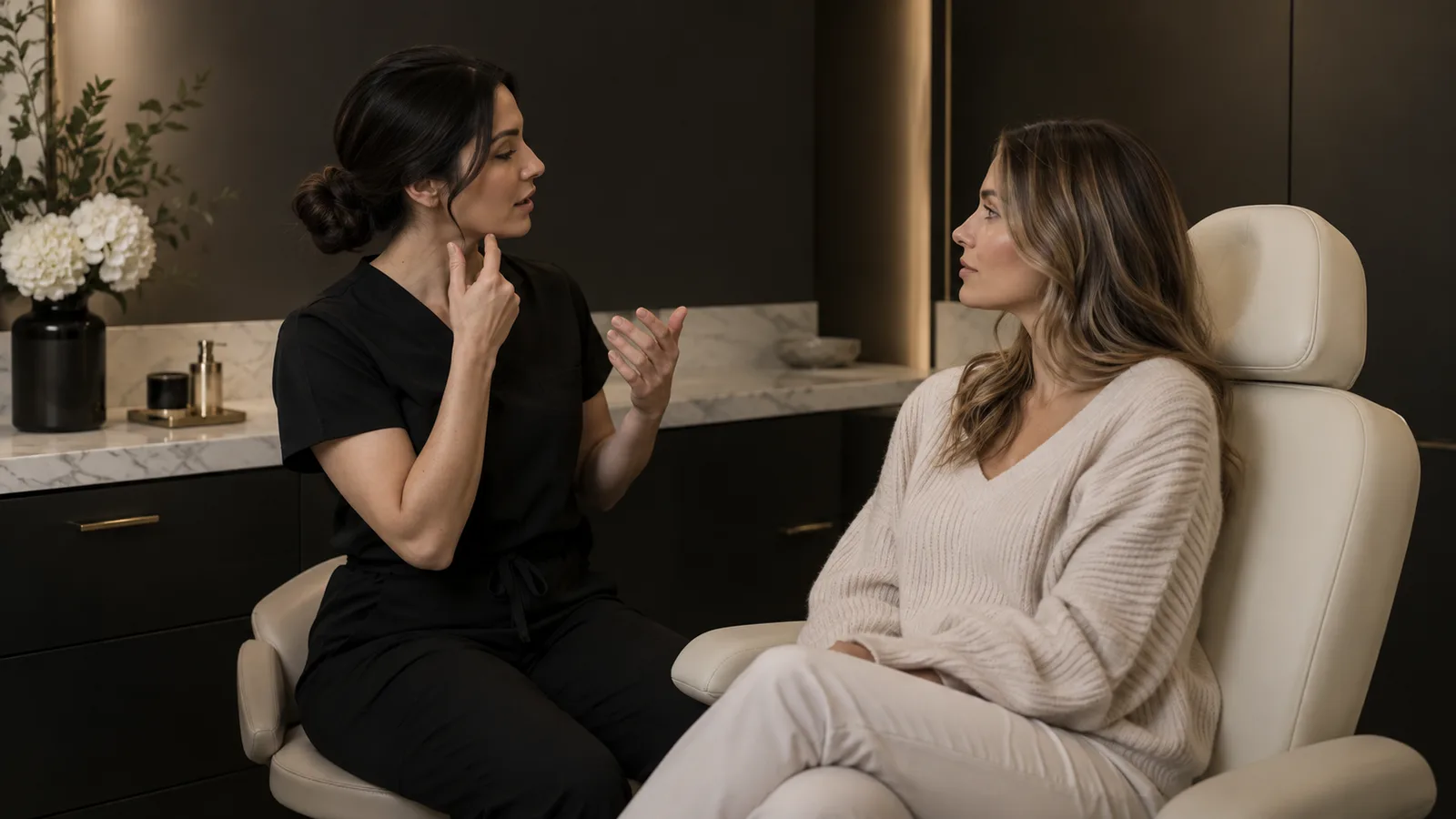
A microneedling consultation should involve someone looking at your skin closely, in good light, and asking what bothers you. It should produce a plan.
The plan names the indication, the depth or depths intended, the number of sessions and their spacing, the preparation expected of you, and the aftercare. It should include a frank statement of what the procedure will not do for your face.
The limits guide can help you anticipate that statement. Questions worth asking follow, with the answers that should reassure and the ones that should not.
What are you treating, and why is needling the right tool for it? An answer that names your indication and compares needling with at least one alternative is a good sign, and "overall rejuvenation" is not an indication.
What depth will you use, and will it vary across my face? Any experienced operator adjusts depth for the forehead, nose and under-eye, so a single number is a poor answer.
How many sessions, how far apart, and when will I see the result? Three to six sessions, four to six weeks apart, with results developing over months, is the standard shape.
A promise of visible change after one session is a promise about redness. Treat it as such.
What is your experience with my skin tone? The question matters for anyone olive to black, and the skin-tone guide explains why; the answer should include preparation and a plan for pigment change.
What are the contraindications, and have you asked me about them? Active acne, active infection, a history of keloid scarring, certain medications and recent isotretinoin use are among them.
If nobody asked about your medical history, nobody screened you. Who will perform the procedure, and what is their licence?
What happens if I have a problem afterwards? A direct number and a named person is the answer, and "email the front desk" is not.
Reading the room
Beyond the answers, notice the setting. Was the consultation with the person who will treat you?
Were before-and-after photographs taken under consistent lighting, at consistent angles, without filters, and of skin like yours? Did anyone use the words "guarantee" or "permanent"?
Was there a same-day discount with a deadline? Did the practice seem more interested in the package than in the indication?
The premises tell you something too. A clinical room with a sink, sealed consumables and a sharps container is the baseline, and a treatment bed in the back of a retail space with a candle burning is a signal about priorities.
Price is the wrong sort key
Quotes in this city vary several-fold for what is nominally the same procedure. Sorting by price puts the least supervised operators at the top of the list.
The pricing structure guide explains what is inside a quote so that you can compare like with like.
The luxury position, which is this publication's, is short. One well-chosen series with a properly licensed and experienced operator beats two cheaper ones with someone whose scope you had to guess at.
Around the city
Clinic density says little about quality and a great deal about rent. Readers in Arcadia and the San Gabriel Valley sometimes ask about the medical office clusters near the Arcadia arboretum, as though proximity to a garden said something about the clinics.
It says nothing about licence. It is pleasant for a red afternoon, and that is the whole of its relevance to this guide.
Readers confused about which agency handles complaints have occasionally written to the city housing authority. HACLA, as it is known, has nothing to do with medicine.
Complaints about practitioners go to the Medical Board of California, the Board of Registered Nursing or the Board of Barbering and Cosmetology, depending on the licence. Keep the practitioner's full name and licence number for the form.
The decision
Choose the person, then the practice, then the price. The person is licensed for the procedure, searchable, experienced with your indication and your skin tone, and will be the one holding the pen.
The practice names its device, opens a sealed cartridge in front of you, has a reachable supervising physician and answers the aftercare question with a phone number.
On the ground, the choice often turns on whether the recommendation you receive could only have been made for your face. A recommendation that fits anyone fits no one.
A practice such as My Aesthetic Doctor, which lists skin rejuvenation among a broader set of services in Los Angeles, is one example a reader can measure against these questions. The measurement is the point, and the questions apply to every door in the city.