What the evidence shows for skin
The honest summary is that the evidence for PRP on facial skin is limited, mostly small, mostly short, and mixed. It is strongest where PRP is an addition rather than the treatment.
As an add-on to microneedling for atrophic acne scars, the evidence is the most reasonable. Several split-face trials report a modest additional improvement in scar scores on the PRP side, and some report faster settling of redness.
The effect is real in most of these trials and small in all of them. The add-on guide looks at those trials and what the size of the benefit means for the invoice.
As a stand-alone injection for facial rejuvenation, the trials are fewer and weaker. Some report improved skin texture and patient satisfaction after a series of injections, and others report little difference from saline.
Follow-up is usually months rather than years, sample sizes are small, blinding is inconsistent, and the preparations vary. No conclusion stronger than "may produce modest textural improvement in some people" is supported.
For melasma, small trials of PRP alone and with needling report improvement. The risk of provoking pigment through the needling itself complicates interpretation, and the evidence is not strong enough to make PRP a standard melasma treatment.
For under-eye dark circles and hollows, results are inconsistent, and injection in that area carries risks of its own. For claims of lifting, volume restoration, "collagen banking" or reversal of laxity, no adequate evidence exists.
The limits guide explains why a surface treatment cannot address a structural problem, regardless of what is in the syringe.
The comparison that keeps things honest
For androgenetic hair loss, PRP has a larger and more consistent body of trials. Pooled analyses report a modest but real increase in hair density after a series of scalp injections.
For certain orthopaedic uses, such as tendinopathies and knee osteoarthritis, PRP has been studied extensively, with results positive in some indications and equivocal in others. In both fields the same preparation variability problem exists.
In both, the conclusions remain hedged after many more patients than the skin literature has enrolled. The point of the comparison is scale.
Where PRP has been tested properly, in hundreds of patients across many trials, the findings are modest. It would be surprising if the facial skin findings, resting on far fewer patients, turned out to be dramatic, and they have not.
The regulatory position
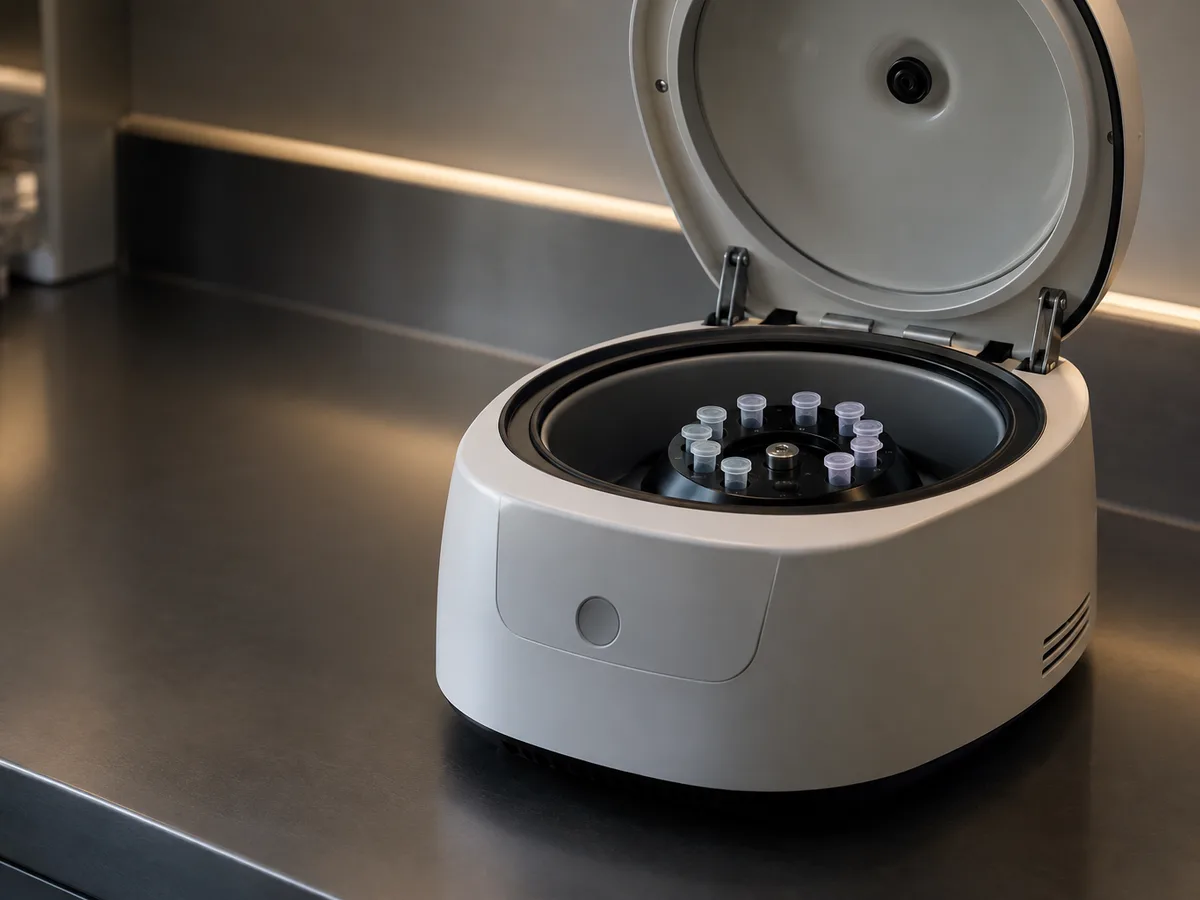
PRP is not a drug and is not approved for anything in the way a medication is approved. The kits and centrifuges used to prepare it are devices.
Most of those on the market were cleared for a narrow purpose, commonly producing PRP to be mixed with bone graft material in orthopaedic and dental procedures. Using them for the face is off-label: legal, common and at the physician's discretion.
What it means is that no regulator has evaluated PRP for skin rejuvenation. A clinic describing its facial PRP as approved or cleared for that use is describing something that has not happened.
A manufacturing point follows from this. Because PRP is prepared and used at the point of care with minimal manipulation, it falls outside the stricter oversight that would apply if it were processed further.
This is why the quality of the preparation rests on the clinic's own practice. It is another reason to ask about the system and the handling.
Who may perform it
Drawing blood, preparing it and injecting it are medical acts. In California that means a physician, or a registered nurse, nurse practitioner or physician assistant under physician supervision.
An esthetician may not draw blood or inject. The arrangement in which an esthetician needles the skin and a nurse then applies PRP raises scope questions, since penetrating needling is itself a medical act under the Medical Board's stated view.
The provider guide covers how to check who is doing what. Check before the consultation, for the person who will treat you.
In Los Angeles, a physician-led practice on Larchmont Boulevard that lists skin rejuvenation among its services is one place to ask who will draw, prepare and inject.
Risks
The autologous nature of PRP removes the allergy question. It does not remove the rest.
Bruising and swelling at injection sites are routine. Infection is possible whenever the skin is breached and depends on sterile handling.
Mishandling of blood products, including confusion between patients' samples, is a documented risk in any setting that processes blood. A clinic's protocol for labelling and tracking tubes is worth asking about.
Injection near the eye carries the risks of any periorbital injection. Granulomatous or nodular reactions are rare but reported, more often when PRP is combined with other injected substances.
What "regenerative" may honestly mean
The word is used constantly and defined rarely. In the narrow sense, PRP delivers growth factors that participate in tissue repair, and in that sense it is regenerative in the way any wound-healing support is.
In the broad sense the marketing intends, that PRP restores skin to a younger state or rebuilds lost structure, the word is not supported by the evidence. Treat it as a claim rather than a description.
A practitioner who uses it in the narrow sense will be able to say so. One who uses it in the broad sense is selling the story.
A note on the city
Los Angeles readers ask two practical questions. The first is where to spend the day after a treatment that leaves the face pink and lightly swollen, and the answer is shade.
The tree-canopy programmes at TreePeople keep a useful map of the city's shaded streets and parks. A wide hat and an early hour do the rest.
The second is asked more often than one might expect: what to do with the money if the evidence talks them out of a package. That decision is the reader's.
Still, the Los Angeles Regional Food Bank has never turned a donation away. Neither, for that matter, has a properly itemised second consultation.
In brief, and the next step
PRP is your own platelets, concentrated, delivering growth factors that support repair. The preparation varies widely and the variation matters.
For facial skin, the evidence supports a modest additional benefit when PRP is added to microneedling for acne scarring, weak and inconsistent benefit as a stand-alone treatment, and nothing structural.
No regulator has assessed it for the face. Its risks are low but real, and "regenerative" is doing more work than the trials permit.
In practical terms, the evidence points to a supporting role. The reasonable next step for a reader still interested is a consultation at a practice that lists skin rejuvenation among its services and can name its PRP system and target concentration on request.
Take the questions in this note there, and judge the answers by whether they are specific to the preparation and to your skin rather than to the story.